Commoning, diversity, and small-scale manufacturing: drawing parallels between bread and linen
Tyson Yunkaporta, indigenous academic and Australian deep-thinker, has described how, if we are to address the polycrises and create a long-term liveable planet, we need diversity. Diversity of thought, process, peoples, concepts, ecosystems, everything. (Donald Trump is doing everything he can to limit diversity in the US, because perhaps instinctively he understands it has the potential to moderate or even thwart capitalism.)
We humans depend on methods of production to provide the goods we desire for a comfortable and fulfilling life. We must produce these items less harmfully and, to enable this, will require diversity in production. A healthy ecosystem is diverse, and small-scale manufacturing systems have the potential to contain much more diversity than industrial levels of production. I use bread and linen – basic daily items of food and textiles – to illustrate this position.
Climate change is creating unpredictable, wildly variable weather patterns which makes farming for food and fibre production more challenging. Our agricultural systems need to develop conditions of resilience and diversity can spread risk. Large-scale systems of production require individual concentrations of power and homogeneity. Once you have acquired the capital and purchased an expensive, large metal machine for manufacturing goods, be that food or clothing, you can only feed it what it was designed to consume. If the raw material feeding the machine changes in some way, for example due to a shift in climatic conditions, it may be difficult or impossible for the machine to accommodate it.
Take the basic human staple of bread, a farmer does not know whether a season will bring intense rain or drought, and so can balance the risk by growing different varieties. Heritage grains, landraces, and population wheats grown for flour all bring diversity into an arable system. In the case of population wheats, this happens within the same crop. The soil, fungi, bacteria, and insects that surround fields also like variety – this keeps an ecosystem healthy and alive as it is constantly evolving and adjusting.
Modern wheat is bred for increased yield, but with this comes a reliance on inputs sold by the same companies who are selling the seed. These patented varieties are increasingly bringing more risk to the farmer because their conditions are as fixed as weather conditions are variable.
Most farms in the UK grow a single variety of wheat and this suits the calibration of large-scale milling machines. Innovative farmers are adapting to climate change by growing heritage and population varieties to create diversity and resilience. The South West Grain Network includes farmers, bakers, and millers working collectively to grow grain that adapts to a range of weather to enable long term food security and improved biodiversity. Open-minded, large-scale millers may wish to process these new grains, but their systems and machines find it very difficult to accept difference. Small-scale millers figure out how to mill variable grains on machines they can calibrate and adapt. The bakers within this network also learn to be flexible and bake with a variety of conditions that the flour produces. It is a challenging but rewarding endeavour that requires dedication, patience, and knowledge exchange.
Over the past year I’ve visited a range of textile mills becoming aware of how machinery dictates the outcome of the yarn and the possibilities of design. This sounds obvious but, as a designer, it’s not until you understand the machine that you can understand your latitude as a maker.
Take wool for example, assumptions are often made that a wool mill can transform any kind of fleece from the back of a sheep into any kind of yarn, but this is untrue. An experienced hand spinner has a direct relationship with a raw material, be that wool or flax and can respond to the fibre’s strengths to achieve results so much stronger or finer than a mill could. Manufactured yarn is a multi-step process requiring many kinds of machinery to enable specified outcomes controlled by settings in response to the raw material input. Machines cannot react in the way that hands and eyes can.
Currently we can’t process flax into yarn in the UK and, if we were to invest in new machinery and set up a supply chain, it would cost millions of pounds. Flax is a form of cereal, grown to produce linen. Agriculturally it is similar to wheat and open to the vagaries of weather. When the yields of a crop are variable, investment in expensive machinery is a difficult case to make, irrespective of any political and ethical persuasions.
As the biggest growers and processors of flax in the world, the French are starting to change their growing practices as crop outcomes are no longer dependable. If we are to develop new textile systems that work in partnership with nature, it makes sense to respond to the variability of our climate. Working at a small-scale reduces risk and allows for adaptability.
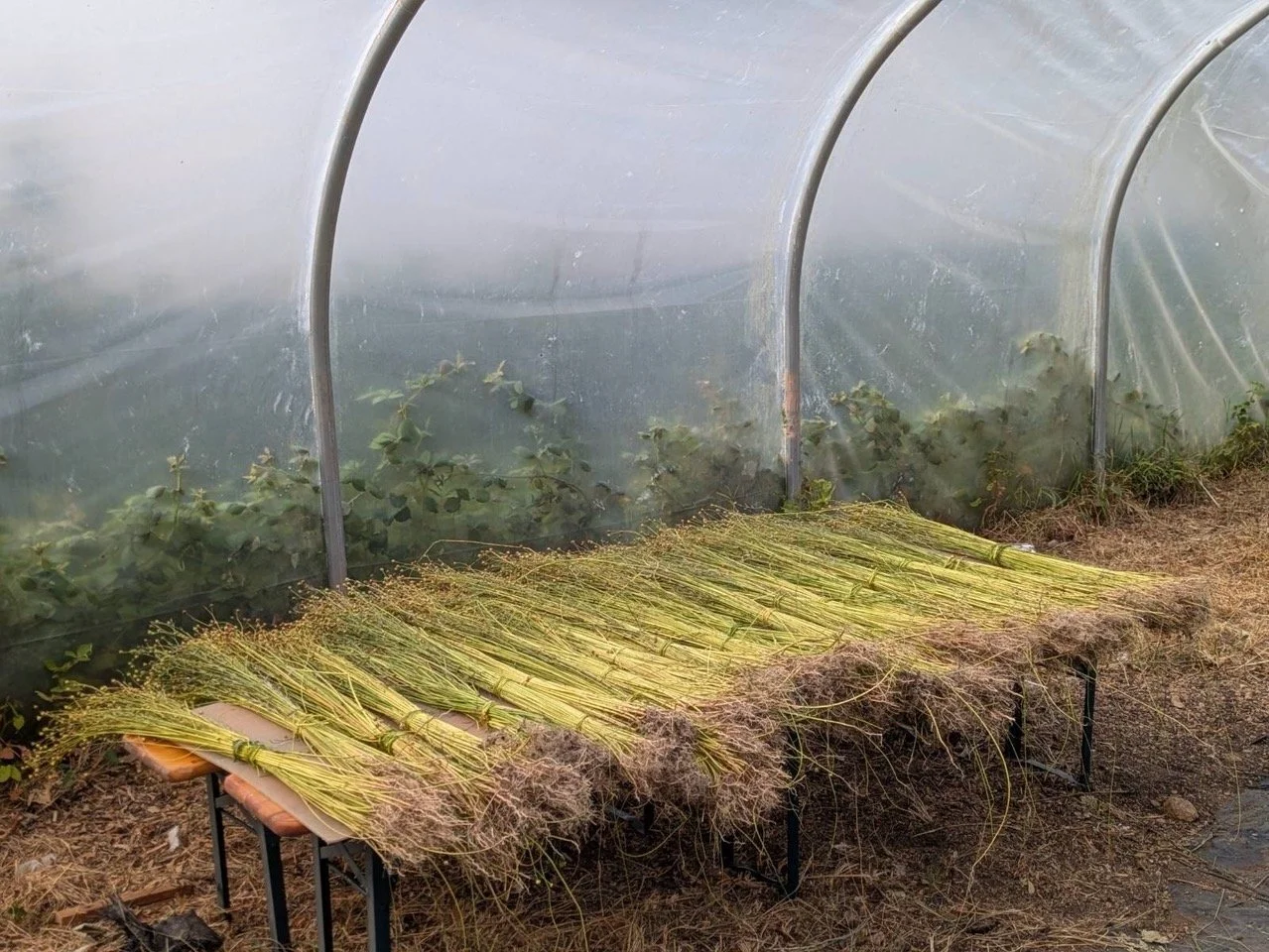
Small-scale flour mills like those owned and run by Fresh Flour in Devon and Field Bakery in Somerset are inexpensive to set up and allow experimentation and adjustment. These businesses work with different grains to produce pasta and bread from locally grown, unusual flours that taste both different and delicious. Eating and experiencing this food is an enjoyable and memorable experience.
In Tools for Conviviality, Ivan Illich describes a need for society to enable conviviality, relationships, and energy use at a human scale. In Small is Beautiful, also published in 1973, E.F. Schumacher asks for cheap, small-scale methods compatible with the human need for creativity, with the cost of any machine in balance with the wage it is possible to earn from it. Production should be owned by workers who are developing relationships and products at a human scale. Work should not only be understood through the lens of capital and rationality, but should provide a life worth living. Schumacher also states that small-scale operations, no matter how numerous, will always be less harmful to the environment than large-scale ones. These are fairly simple concepts, generally ignored due to the prioritisation of profit, but difficult to dispute in relation to human and planetary thriving.
Fantasy Fibre Mill develops small-scale, inexpensive, textile processing machinery to enable the production of linen textiles in the UK. Nick Evans, a Director/Inventor, recently supported Brigitte Kaltenbacher, a community flax organiser and weaver, by spinning yarn from communally grown flax so that Brigette could weave a linen jean. The cloth produced by Nick and Brigitte has a character not found in a standard jean; they worked together, iteratively adjusting the yarn to weave an item of clothing that contains the input, love, and learnings of many people.
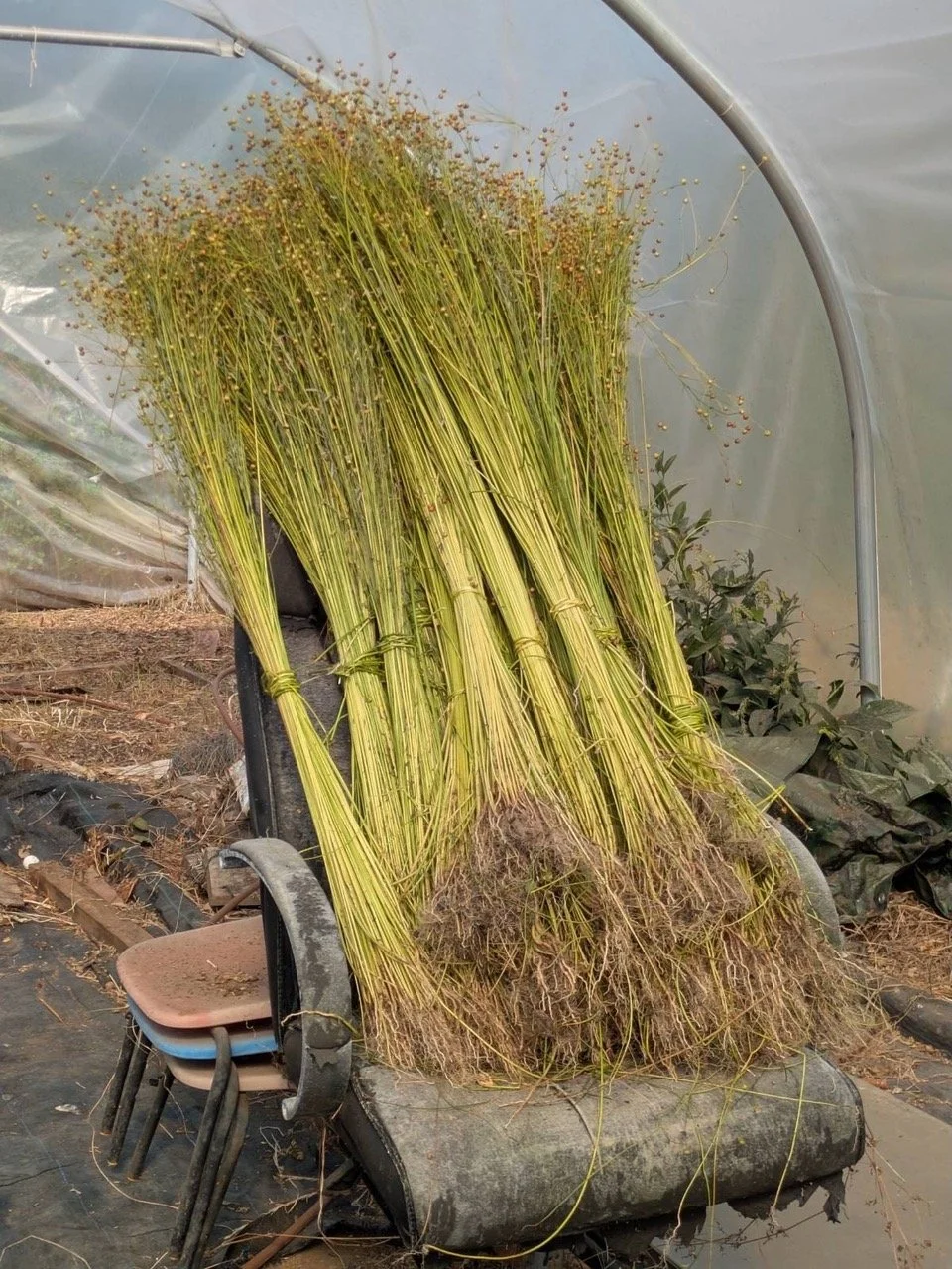
Image courtesy of Selby McCreery
Crafting textiles by hand is an enjoyable but VERY slow process, requiring multiple artisanal skills. The help of machines is required to make any decent amount of cloth. The flax to linen machinery, developed by Fantasy Fibre Mill, consists of a breaker, scutcher, hackler, and spinning machine. It can be put together using easily available, inexpensive parts. This human-scale supply line is operated by one person with some energetic support. Although the system is not quite ready to produce enough yarn for more than a small sample at present, it is evolving and improving every day through the personal dedication of Nick and a collaborative support network of fellow enthusiasts.
In textiles, we are looking for a sweet spot that reduces the time and cost involved in making by hand, whilst retaining a creative, adaptable, less harmful process. As Illich states, “convivial tools are those which give each person who uses them the greatest opportunity to enrich the environment with the fruits of his or her vision.”
Illich’s musings have inspired many modern communicators and scholars of the commons. I recently had the pleasure to speak at ‘Conviviality, Culture and the Commons’, the inaugural Schumacher College ‘Wild’ event following their independence from Dartington Estate. I explained the ways that commoning informs my work and how it shapes social networks, knowledge, cultural practices, and resources, which are shared for the benefit of everyone.
In its simplest form, commoning is an activation of community. It begins with field building, learning, and developing relationships with people. This is how South West Grain Network’s work with grain and bread started, it’s how the Bast Fibre Network, a group I convene around the subject of flax and hemp, began. People meet, talk about a problem, and as they develop convivial relationships, trust develops, and together, they make things happen.
Just as the South West Grain Network is developing bread in different ways, the South West England Textile Commons seeks to develop textiles through embracing difference, incorporating diversity, and developing the flexible systems and processes that allow for this. Stewarded by myself (Liflad), South West England Fibreshed, Wessex Community Assets, and Fantasy Fibre Mill, and involving many other collaborators such as Flaxland, Transition Town Totnes, and The Flax Project Plymouth, our project is figuring out a more convivial process to grow flax, produce linen, and other related materials within our local context.
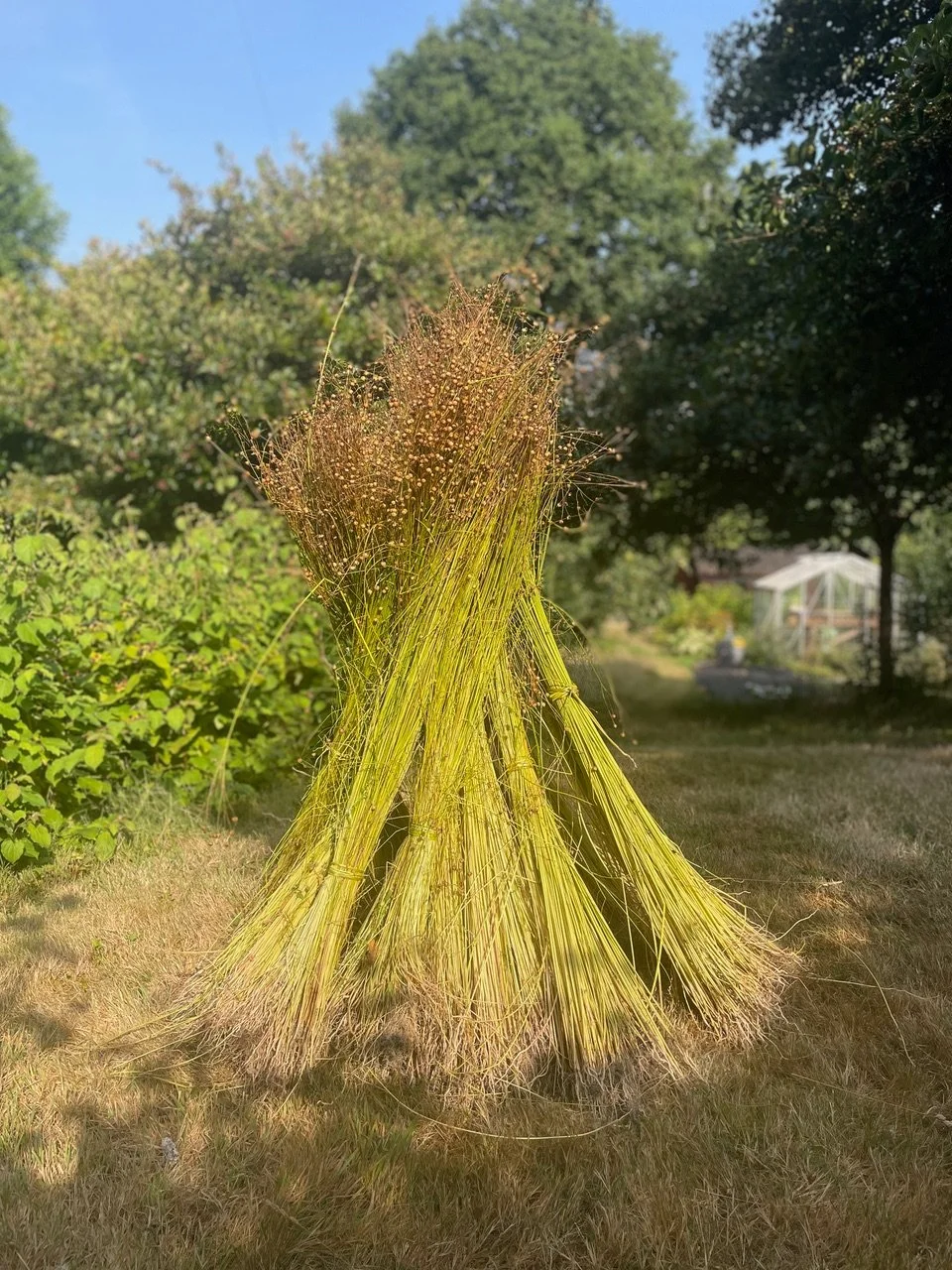
Image courtesy of Selby McCreery
The methods we develop will be mindful, allowing us to respond to what is grown in a particular year. The tools will be inexpensive to construct and enjoyable to use, operating with minimal energy. Perhaps the textile producer will grow the raw materials and dyes, process them when the sun shines, stitch and weave in the winter, and sell the outputs within a cyclical, seasonal, community-supported system.
In a traditional business, an entrepreneur is encouraged to network and develop relationships with the aim of raising investment. In the South West Textile Commons, we use the frame of commoning to raise and share funding as a collective, undertaking a similar process but underpinned by completely different values.
We hope that a cooperative ecosystem that feeds multiple enterprises will ultimately emerge, involving distributed decision making, distributed resources, and distributed benefits. Learning together, experimenting, researching, testing, sharing innovations and adventures across South West England, working towards our aim of supporting land-based bioregional livelihoods centred around textiles and related natural materials. We don’t know the details yet but are collectively working this out, at the speed of trust, taking small but steady steps.
Diversity in production will not ‘make us money’ because it will always take more time. However, if we work together, it may become possible to earn a living. In these turbulent times, we need to steadfastly embrace diversity. Small-scale, bioregional clothing commons can facilitate this through the flexibility of process and outcome, through the seeds that are planted, crops that are grown, and products created convivially and creatively in community.
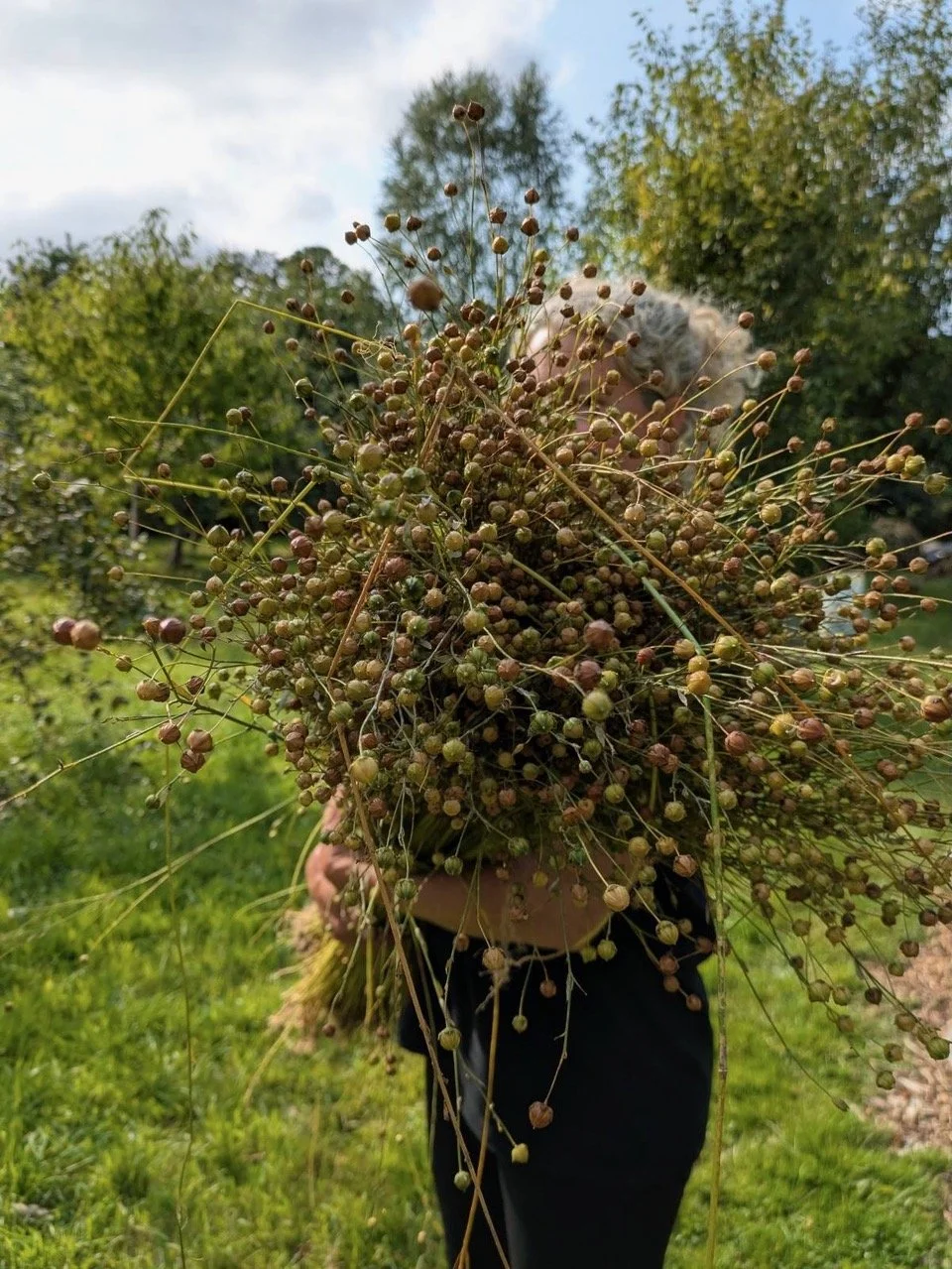
Image courtesy of Selby McCreery