Eco-somatics and Collective Imagination – Broadening Perspectives for Climate Transition Discourse
The air is crisp outside and the days are slowly growing longer. As winter invites us to slow down and bring our attention more inward, I have been reflecting on the last six months of my research.
I have been exploring how eco-somatics and collective imagination add different layers to the discourse on climate change and broaden perspectives by contributing through sensory approaches and body-based knowledge. I felt the need to complement predominant discourses on climate transition with practices that are situated in the body, in co-creativity with plants and which have the capacity to embrace subtle realms of more-than-human life forces.
Engaging in movement-based practices is often a way for me to access liminal experiences beyond words – to meet the complexity of processes through embodied knowing.
Yet, in this research, I had a particular interest in developing a vocabulary for weaving what transcends words back into the conversation, so that somatic practices of fine-tuning with the land can gain visibility and become an integral part of our engagement with the topic of climate transition.
The research project emerged from the question: How can we approach climate transition discourse from a different angle and explore the possibility of decentring human-focused narratives, while rooting our knowledge-making in our bodily experience?
To find possible answers to this enquiry, I re-examined the eco-somatic and imagination practices that constitute the workshop Transitional Momentum for Ecological Grief. A workshop I developed as my MA thesis in Movement, Mind and Ecology at Schumacher College in 2024. The workshop holds space for tending to feelings that accompany phases of profound socio-ecological change while exploring the creativity inherent to transition processes.
Sharing the workshop in different places ranging from urban gardens to universities over the past two years allowed me to learn further about the methodology through the participants' responses. In line with my research question, I wanted to understand on a deeper level how exactly eco-somatic and imagination practices seem to offer a different roadmap for navigating conversations on climate transition.
Embodied Listening
My research proceeded in several phases. As a first step, I organised weekly sessions entitled ‘Attunement with plants’ in Prinzessinnengarten, an urban garden and former cemetery in Berlin. Through these sessions, I could revise my eco-somatic approach and deepen my understanding of collaborations with plants in a communal setting.
Eco-somatics is a body-based practice that bridges soma, the Greek word for body, with eco, drawn from the Greek word oîkos for dwelling place / home.
The exercises I facilitate guide participants gently into awareness of their own body and breath, inviting them into a larger perception of the environment and into resonance with a particular place or plant. Eco-somatics draws simultaneously inward and outward, emphasising the relationship between inner and outer ecologies.
An example of an eco-somatic exercise would be to tap into the interrelationship between bodies of water – the fluids within the human body, as we are made of 60% water, and the flow of water and sap in a tree. I’d draw on myofascial release exercises that enhance the movement of fluids in the body. Fascia is a continuous web of connective tissue wrapping around every muscle, organ and bone, strongly connected to the circulation of body fluids, facilitating hydration and cellular communication. By taking the element of water as a connector, one can imagine and sense into the micro-resonance between the fluids in the fascia system and those in a plant’s vascular system.
Here, imagination acts as an entry point to connect with what is not visible to the naked eye. It’s an exercise of fine-tuning perception to the parallels and potential vibrational resonance between bodies of water. The visualisation brings attention to what is not apparent at first glance and opens us up to a sensory exploration of what is possible. Visualising the flow of fluids creates an embodied awareness that informs how we move, leading to an integrated physical state of our bodies in relation to our environment, ultimately becoming body memory. This facilitates a different way of moving within the relational field. Working with the fascia literally connects us with our nature, inside-out.
These processes of attuning to minute resonances between human and more-than-human bodies through visualisations draw on Ideokenesis – a practice commonly applied in physiotherapy and dance studies to gain embodied knowledge of anatomy and inner organ landscapes through imagery.
Developing such heightened sensory awareness is like training a muscle, similar to how a sommelier trains their taste buds to recognise through the flavour of the liquid the terroir where the vine grew. It is not a rigid training, but rather one of yielding into bodily intelligence and developing listening capacity over time.
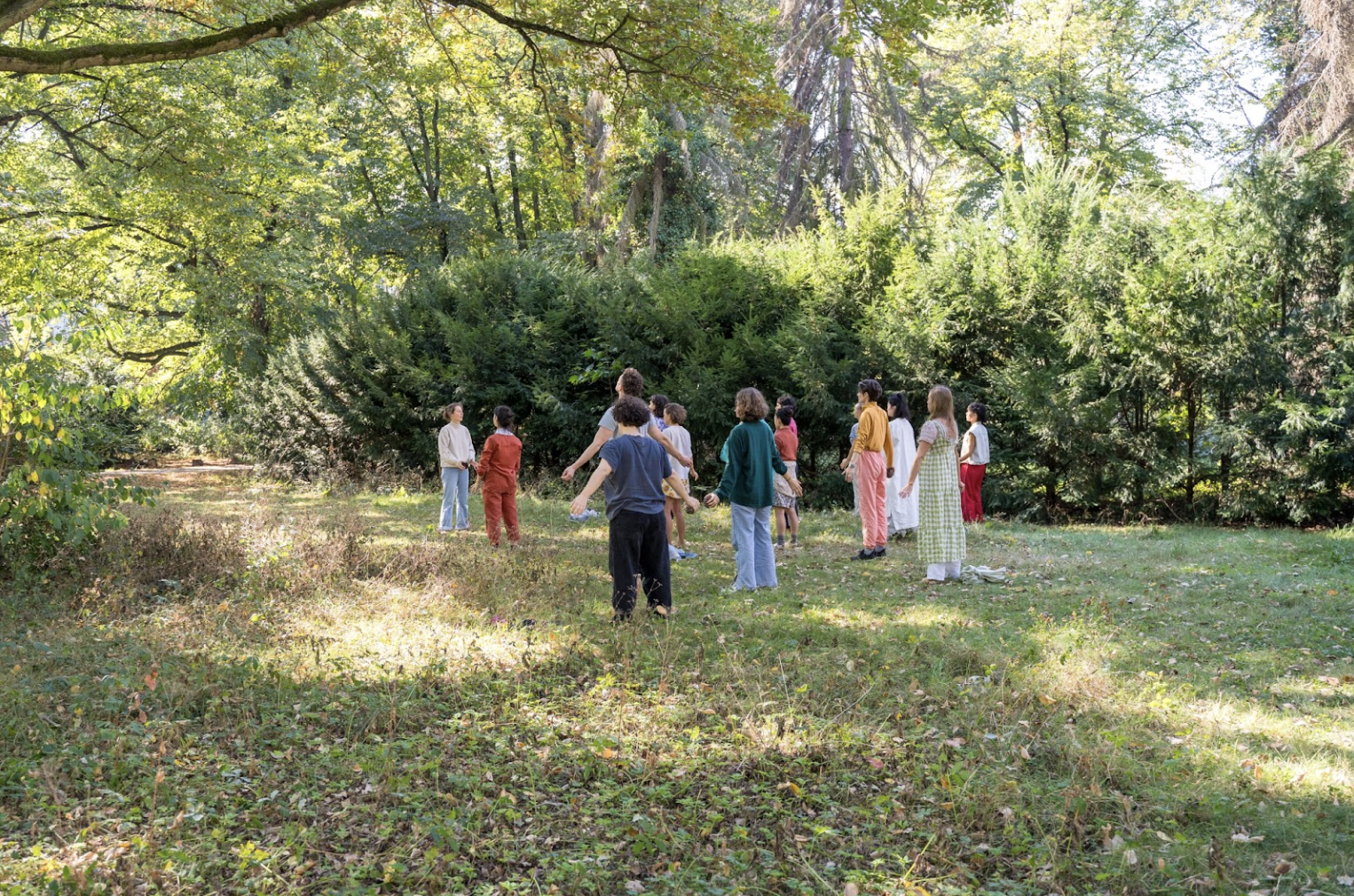
The sessions at Prinzessinnengarten made me aware of how eco-somatics strengthens kinesthetic empathy; Sensory experiences ground us in an embodied understanding of our entanglement with larger ecologies. This more tangible sense of interconnectedness grows compassion for the losses and destabilising changes other species are experiencing.
At the same time, we can also learn from their forms of adaptation and creative transformation, becoming receptive to the creativity and wisdom of the Earth.
When we attune through practices of embodied listening with our environment, there is a different form of knowledge-making that ripples through the channel formed between our bodies and the land. This kind of knowledge can provide insights on how to support other beings and ecosystems through change and how to find inspiration ourselves for navigating climate transition. Eco-somatics creates a framework where the firm grip of the mind softens and one starts to listen.
Such listening practices create a movement from having conversations about the earth into reciprocal communication with bodies of land, water, and more-than-human beings – the discourse on climate transition becomes a generative mutual exchange, mending a divide.
Interspecies Creativity
Inspired by the research process thus far, I made it a continuous practice to ask a plant:
“What would you like me to know in relation to climate transition?” 1
I experienced a lot of creative flow in this interspecies contact zone – where I listen and root in the present moment, exploring with curiosity, the kinds of non-linear responses that emerge through this encounter, from my corporeal intelligence in the intuitive state of ‘not knowing’.
The replies unfold more like petals of a flower, sometimes over longer timespans, sometimes with striking immediacy, and they don’t come through in verbal language.
It is the ability of the body to be receptive to other forms of expression and to let them shape-shift into a thought or an image through an alignment between plant, earth, body and mind.
The plant's being can be in contact with my body, as I'm a porous being, meet my consciousness and be translated by my sensory awareness into an image or a thought.
Eco-somatics is a practice where the mind lets go and through a softening of the cellular tissues, there's an opening – remembering other ways of being in conversation.
Spending time in this liminal zone, where my mind surrenders to ‘not knowing’ and feels the abundance that resides in this way of co-becoming, requires trusting my intuition and imagination. It requires trusting too, that my education as a dancer and body practitioner has equipped me with the necessary tools to trace minute sensations. The creative faculty of imagination, once more, offers an entry point into more subtle realms. Imagination, not understood as a fantasy, but as the capacity to move beyond what we know, beyond the binary – creating an opening to what is possible and transcends conventional, deductive pathways of knowledge making.
This practice of listening to the land with our bodies, as part of the land, is very old – it is more about remembering than about learning something new. It is an ancestral practice of relating with the land.
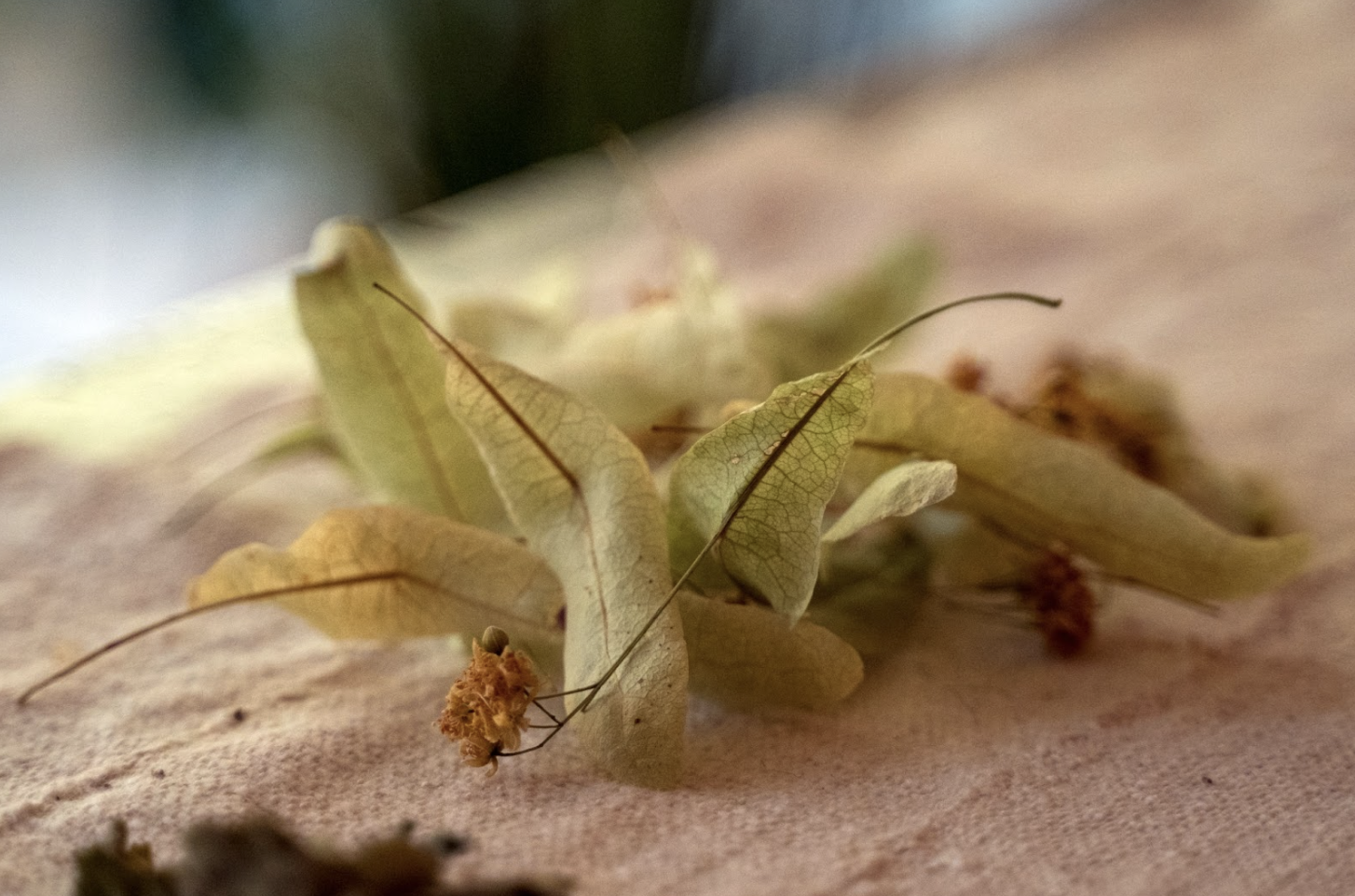
When I went on walks, carrying a question in my gut biome and listening for which plant I'd feel invited by, I savored the humbling fact that plants have so much more experience than humans in navigating ecological transition processes. It came as no surprise that the plant's companionship was heartfelt and some deep, meaningful insights unfolded.
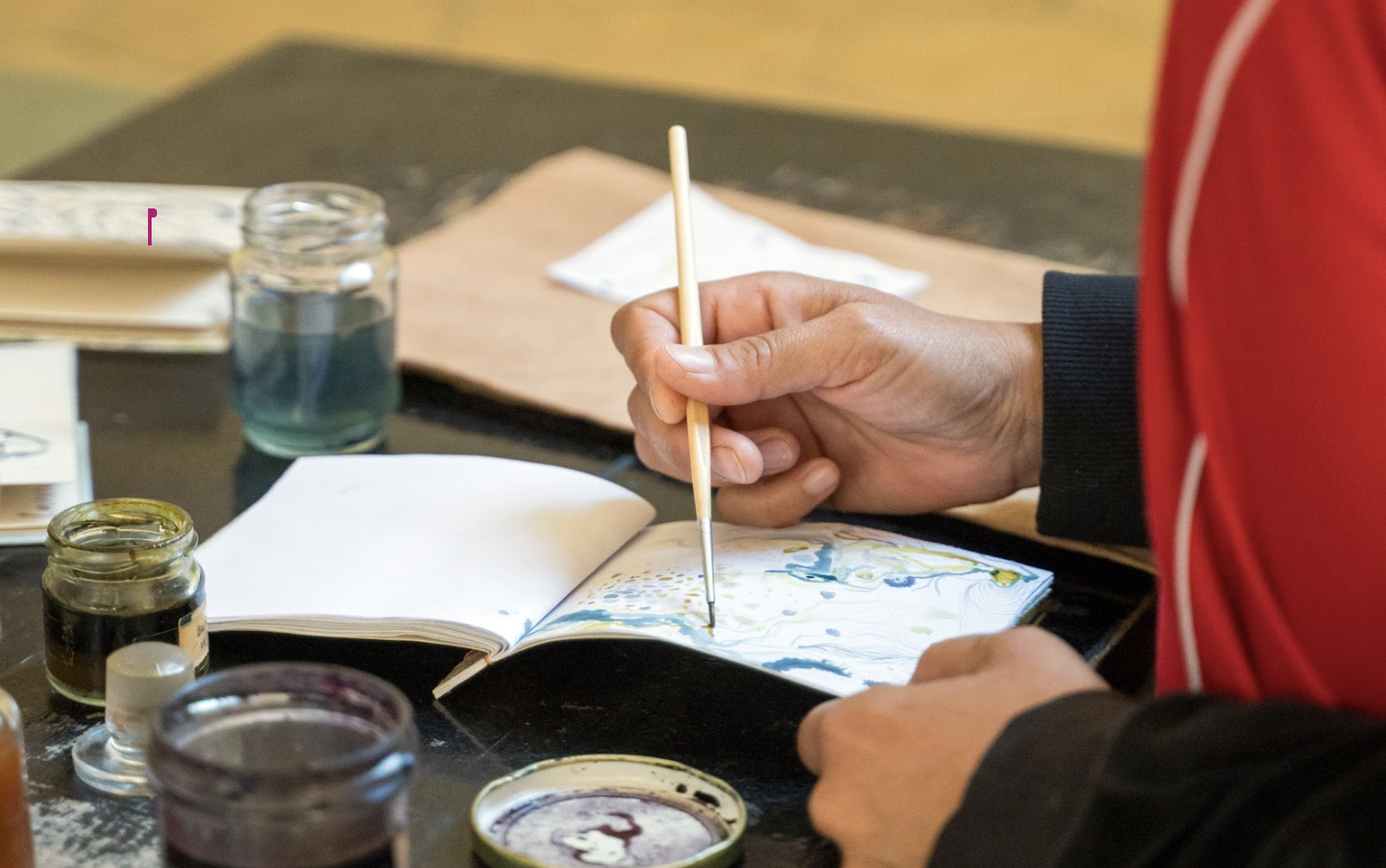
In parallel, I have been broadening from my experiences with plant companionship to more collective ones. For example integrating this practice into my workshops and asking friends to go on a walk with the same prompt. It has been beautiful to observe how each person‘s experience is unique, how perception has myriad ways and at the same time, I started to notice overlaps and similarities, especially when people were attuning with the same plant or place. By now I have a small collection of notebooks in which participants from different workshops have drawn what they experienced in companionship with a plant and the sensations they traced inside their bodies. Over time patterns have become more apparent and I have started to discern alignments with properties documented through other sources – different modes of research seem to lead to findings that relate and complement each other.
Deep Time and Feeling Body
Alongside these mappings between body and plant, another aspect of eco-somatics started to dance in the foreground: time can move differently. Through embodied listening and eco-somatic practices we can experience an altered perception of time: tapping into ‘nature time’ or ‘deep time’, which is more expansive and multidimensional. By deepening our awareness of cyclical movements and imagining beyond human time scales, we can envision more easily possible future scenarios that refer to a different concept of time and take our collective imagination beyond existing human narratives, opening up myriad possible futures.
At the same time, eco-somatics brings us viscerally into our bodies.
Coming into our bodies is often connected with slowing down and becoming aware of our feelings. Being able to trace the repercussions of human-inflicted planetary imbalances as small perceptible movements within our soma. A space opens where we come into contact with the tremendous grief we experience on an individual and collective level.
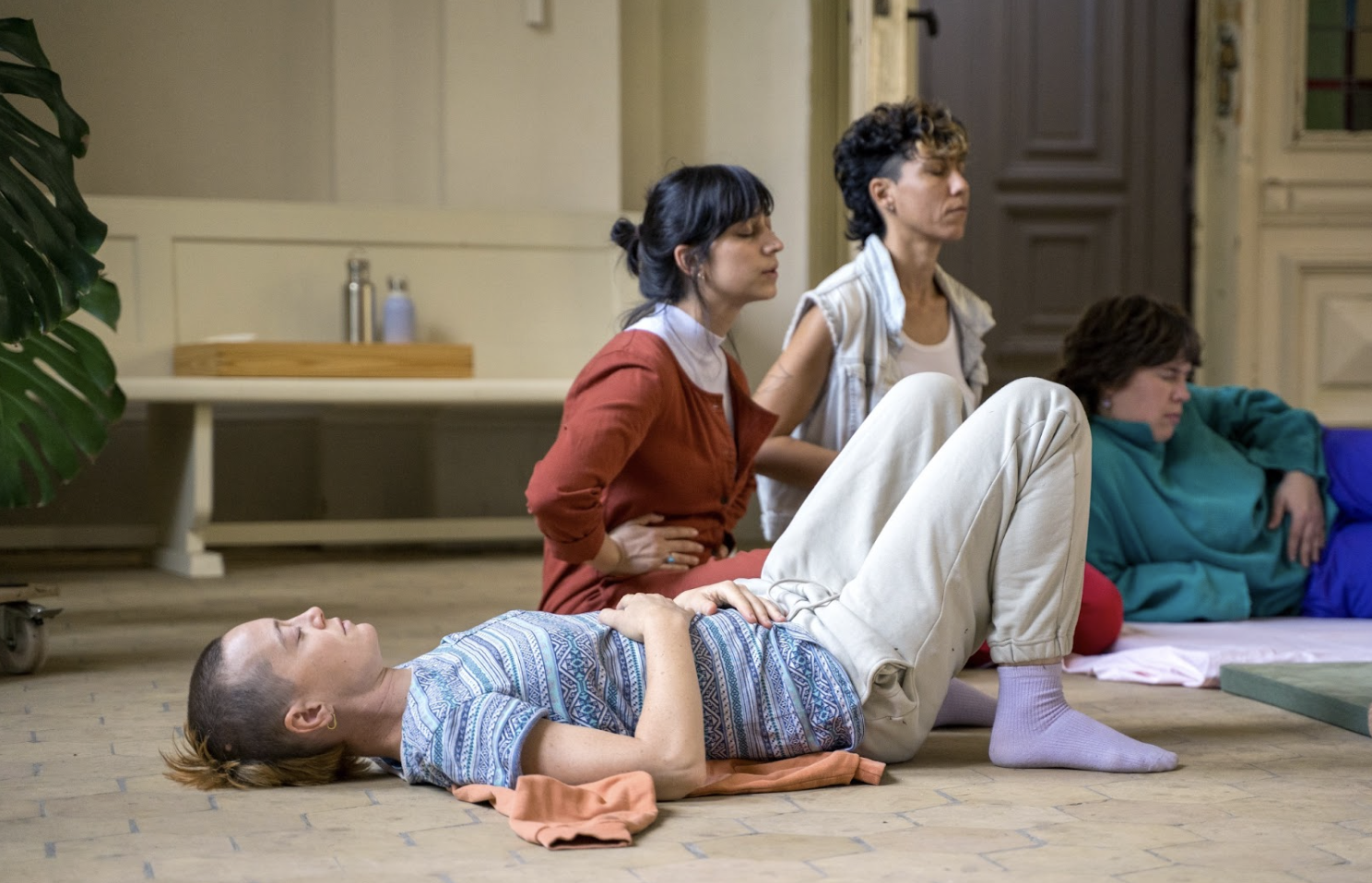
As I had experienced previously with the workshops of my MA thesis, metabolising and dealing skillfully in a communal setting with the wide range of emotions associated with climate transition bears regenerative potential – it creates momentum for transition processes to unfold. Holding space for ecological grief tends to the intergenerational wound caused by extractivist mindsets toward nature and our bodies, as part of nature.
In this research, I have come to see more clearly the nervous system soothing effect of eco-somatics – how it allows us to meet emotions from a grounded place.
This fosters resilience in the face of uncertainty, building the capacity to be in the liminal space of the in-between and to feel the feelings,
to live through questions until we grow into the answers.
Learning to be in a threshold where we can hold complexity and ambiguity without requiring immediate resolution. Yet, we are becoming receptive to the creative solutions that can emerge through unexpected avenues like interspecies creativity.
Collaborating with plants and learning from their ability to regenerate through decay brings clearly into focus the creative, regenerative potential within crisis and decomposition. As we get in touch with our grief, we begin to feel the interrelation between joy, grief and love – letting ourselves be moved by all of them. In my workshops, I witnessed how ecological grief is also an expression of deep love and care for the earth. As we are grieving with and for the earth, we fall in love over and over again.
Encountering these affective responses in a communal space often leads people to grasp the reciprocal movement between self-care and earth-care and to engage in both.
Bridging the Divide
Moving forward with this project, I felt called to put my research into perspective by bringing its eco-somatic approach into contexts less familiar with body-based methods and more used to western scientific approaches. Following the invitation from a professor who had experienced one of my workshops the year before, I held a workshop with master’s students of environmental law and spatial sciences at the University of Groningen. My class was centered around The body and collaborations with plants as sites of intuitive knowledge making in times of socio-ecological changes.
Continuing my earlier approach, we explored practices of embodied listening and creative imagination as modes of research that extend from our sensory awareness to create space for the expressions of other-than-human beings to amplify.
The students were very receptive and voiced that they would like to integrate eco-somatic approaches into their habitual research methods. What echoed through the room was the students’ wish to invest more time to listen to their own bodies and intuition.
Bringing my work into this study environment felt like following a deep call to strengthen the dialogue between different fields, so that bodywork, western sciences, and art can go hand in hand. I would advocate that new experiential pedagogies are needed in academia, so that different fields are no longer seen as divided but as congruent.
Teaching at the University of Groningen reaffirmed: When we negotiate questions in relation to climate change on an eco-somatic level, there is the ability to root conversations in our embodied experience, where they touch us and where our bodily ecologies are understood in direct reciprocity with wider ecologies. This enhanced kin-centric ecological awareness allows us to touch upon the agency and healing that lies precisely in the tidal movements of this interconnection.
I conclude that working with the body in collaboration with the earth as a living entity, drawing on imagination, and embracing the collective emotional experience makes it more accessible for many people to explore the topic of climate transition in a way that is resourced. It generates a community-based form of dialogue that has a counterbalancing vibration to the sense of separation in these times.
I believe it is through human and more-than-human connection and versatile partnerships that we can most authentically and creatively navigate the multi-layered socio-ecological crisis. Moving towards a cultural shift where body-based practices, imaginative capacities, western scientific forms of knowledge making and relational knowing complement each other.
When we start to perceive ‘crisis’ as an invitation to reorient and heal on a root level the illusion of separation, we are no longer motivated by anxiety but by curiosity and care.
As my current research comes to an end, there is also an opening and more questions continue to arise:
What happens when we let ourselves be transformed by larger movements of change that invite us to imagine otherwise?
Photos by Alicja Hoppel at Prinzessinnengarten Berlin
This research was funded by The Collective Imagination Practice Community and The Joseph Rowntree Foundation
1 Acknowledging that ‘climate transition’ is a human term for our experience in these times on Earth.