Dinner with an Iceberg
Up in the Alps, near the source of the river Po, the hairs on my arms prickled as I was listening to a story at the dinner table. I hadn't actually wanted the triple-cheese ravioli I was chewing, and the lactic assault forced up a little bile, a body limit, a scale model of the one Andreas was about to describe.
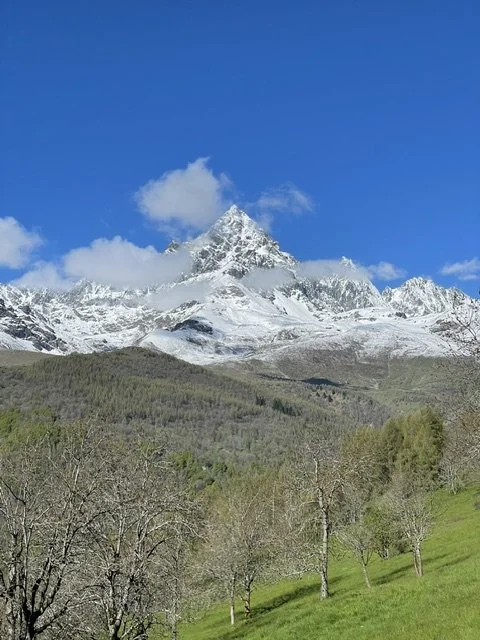
"I stood there in the tunnel, carved out by the washes of salt water, in the pressure point of the iceberg, the deepest blue swelling out all other tones, and after my sight, every other sense too. Nothing to hear but pure pressure, I could smell the faintest musk of penguin from a nearby colony in the north. Once I had given myself over completely, I collapsed: the pressure gone, the blue a distant matrix, and my body, once within the iceberg, now fully integrated with it. We are the same thing…"
"I am having dinner with an iceberg!" I said. But the raised hairs on my arm were sincere. Andreas was describing an almost complete sensory collapse, sight bled into sound, touch into something extrabodily – this was immanence forced right at the earth's inhospitable edge.
I had spent the week at the Mon Viso Institute burrowing holes into land that cantankerously denied human penetration, preparing nooks for juvenile trees. The 'living lab' Tobias Luthe founded is an open experiment in bioregional design. After the week learning about the work underfoot at the institute, Tobias had taken us to dinner as a thank-you for our efforts and invited Andreas, insisting he not spare us any of his story.
Andreas, a documentary film-maker, was recounting the inspiration for his journey to Antarctica, "I had a photo of the ice and snow, Antarctica, it transfixed me as a child, my parents asked why I was so mesmerised, I was obsessed, it was the most beautiful thing I had ever seen."
As if progressing in an imperceptibly slow teleporter, 30 years later his eyes had taken him into the image; he was there. Travelling as a temporary artistic appendage to the Russian boat crew. One year. Six months either way en route, and six months in the coldest spot on earth. Might a quantum observer see the child staring at the photograph slowly transported, particle by particle, to the southern pole? A year on this journey, in inhumanly hostile conditions, with only machinery as incubation. I was intrigued, never having the desire myself to ever go to the ends of earth. What is there at the edge, and why is the edge so far away?
My attention was focussed. Earlier that week, in the car, we'd talked about the urge to scale peaks: that Mon Viso, the mountain we ate under, is something to be mounted, surmounted, as if we must put humanness above it.
What had Andreas encountered at the edge? "What changed in you?" I asked him… "Everything," he said. It was in that sensory collapse that he felt a happiness unlike anything before. This was deep ecology playing out. Andreas, right there at the table, was a chiming bell to Naess's ecosophy: [1] that to comprehend our position within nature, to sense the interconnected web of life, we must surrender to profound, raw encounters with it. [2] As much awe as I felt at Andreas's experience, the conversation in the car, about peaks 'there to be climbed', stuck with me. This is Alpine Europe, after all, where mountain gadgetry – skis, carabiners, ropes, insulating nylon – is an extension of the body. It would be sacrilege to suggest not scaling a mountain at all. Must we all go to the precipice to learn a sense of limits? We do not hear only because of the loudest noise. Nor do we see only because of the most vivid colour. Why does a sense of boundedness seem almost exclusively to be the preserve of the extreme?
A speaker at a conference on degrowth I attended recently said exactly this: that we only come to understand limits by pushing them. [3] If knowing a limit has always meant pushing it, doesn't the climate now demand something else?
Take the raspberry root, something we had spent the week extracting from the topsoil, its slow growth had comminuted the rocks under it. That a raspberry bush grows so elegantly, splitting rocks as it threads through the soil, is the precise opposite of my own impatient tool use. I don't know the first thing about navigating 'through' the earth, where the fracture points are, where the paths of least resistance lie. To raspberries, there is nothing so forceful to overcome. I doubt a growing root knows such a thing as resistance. Are there boundaries to speak of at all?
The sparks jumping off my pickaxe made clear that at a certain depth, the tools become useless and one must get into the earth with the hands. As if the space forces you to forsake gadgetry and get inside it. Boundaries are refusals. You have to trace the contours with your body; the tools won't work all the way. Limits can also be intimate failures! The raspberry and the rock do not limit each other.
Up! The Mountain, In! The Iceberg… what about going around? On the question of mounting Mon Viso… Perhaps instead I would rather circumambulate it, trace its contours through shadows and mysteries. In the Buddhist tradition, circumambulation is a form of reverence, as Macfarlane reminds us. [4] Leaving no mystery, Campagna argues, actively destroys reality. [5] To systematise is to reduce Mountain through language to a position, a note in the network. This is rationality's refusal of what sits outside it: an epistemic and ontological violence.
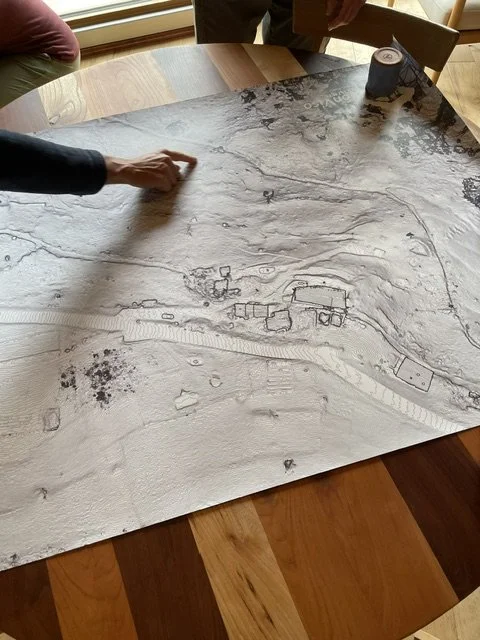
Whilst pulling at roots, I had asked Tobias about boundaries, how does he understand them up here at this place? To him, boundaries show themselves through work: the body pushes, and we come to know our edge, then the world's.
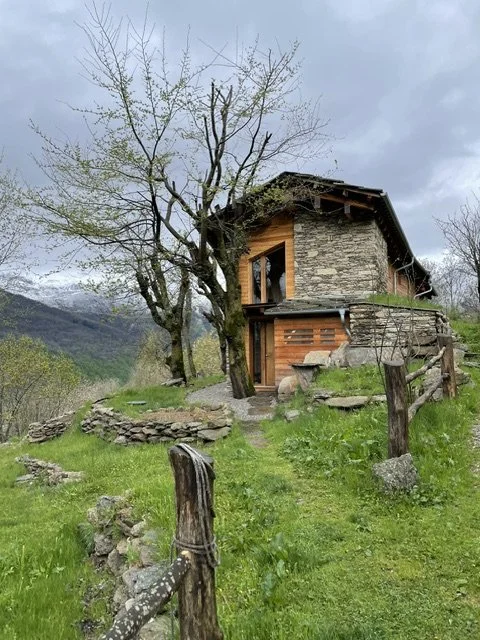
It had rained all week; my hands were wrinkled through moisture, sweat and petrichor intermingling. But this was no unpleasant place to be. The Institute clings to a steep mountain face. Its core structure is Passivhaus: every component calibrated for maximum atmospheric regularisation at minimum energetic cost. In Georgescu-Roegen's The Entropy Law and the Economic Process, energies are never saved as much as temporarily. What Georgescu-Roegen reveals is that once the obfuscation of time is removed, all our extra efforts are simply withdrawn energies from future states. [6] The moral impetus of 'effort' disguises the tax this has beyond the individual. That a boundary can only be known through work repeats the condition that reality must be pushed to be known.
But can all be reduced to entropic decay? To Bataille, the moment when the logic of utility dissolves is the moment reality becomes immanent. Limits become not thresholds or conditions, but a social-biological pressure that demands release through expenditure. [7] Rather than being instrumentalised as functions of scarcity or eschatological anxiety, limits birth meaning. Bataille's energetic eroticism gives a little release from purely scientific enframing, moralistic constructs, and political battlegrounds that pervade the concept of limits and boundaries.
In the iceberg, Andreas encountered a boundary through sensory dissolution: the line between his subjectivity and a deeper relationality gave way. But this happened through the epistemic frame of boundary pushing; body at the extreme, earth at its limit. By giving himself over to the edge, a sacrifice was made: a limit dissolved, and he touched a kind of transcendental immanence. Sacrifice is what energy demands of us, according to Bataille. If the art of sacrifice is sacred, then is the desire to push boundaries sacred too?
Earth, or rather earth's living and dynamic systems, become less resilient the more we reveal them.
In systems thinking, at least at this scale, everything is reducible to a position within a network, whether it still exists or not. Campagna points this out precisely. Measure is only a thin trace of the will to make all things legible. [5] When this way of thinking spreads, everything becomes an instrument, what Heidegger conceived as 'standing reserve'. [8] Measure leaves no room, nor allowance for the ineffable.
Campagna calls this a reality-destroying endeavour. What is reality if nothing can sit outside its frame? The reality system he describes has pushed aside any plurality of realities. It is a closed cosmogony. It does not allow for alternatives. This is not only an epistemological limit but an ontological violence, a refusal of anything that will not submit to its terms.
Stabilising an environment, at least in the pervasive worldview, always demands some form of measure.
The measured, standardised comfort of the Passivhaus sits obstinate to entropy. Its architecture imagines homeostasis, resisting, though only for a while, the liveness of chaos. The homeostasis metaphor runs deep in the natural sciences and bleeds out into our ecological imaginaries. It is so common to hear that nature seeks balance.
When Lovelock and Margulis proposed the Gaïa Hypothesis in 1972, they spoke as scientists watching how planetary systems depend on each other: climate, ocean salinity, clouds, microbes, atmosphere. Gaïa in this sense is the name for that interdependence, a planetary-scale feedback loop. Lovelock suggested it could be read as a self-regulating organism that keeps conditions right for life. The name came from William Golding and was meant to stay ambiguous. Gaïa as goddess, but not mother. [9]
In the climate crisis, we cannot avert what is already unfolding.
This is what Isabelle Stengers calls the Intrusion of Gaïa. A being, not in the sense of a person, but an ontological presence. Stengers warns of simplistic misappropriations of the homeostatic ideas of organism-as-system. The intrusion of Gaïa does not bring balance. It is not the planet. Nor is it a world. The intrusion of Gaïa makes clear that we no longer live in a space of manageable systems. [10]
Had we ever?
Andreas may have encountered Gaïa that day, through a fissure in the imaginary of stability – icebergs can collapse at any moment under their immense pressure that keeps them composed. Lovelock and Margulis could trace Gaïa's workings through scientific instruments, but the very act of tracing showed how fragile those systems were. Only with technology – our gadgetry – do we reach those extremes: sensors and carabiners, and everywhere Gaïa leaves traces: measurements, anomalies, small calamities. But Gaïa is not informational in the sense that earth systems are.
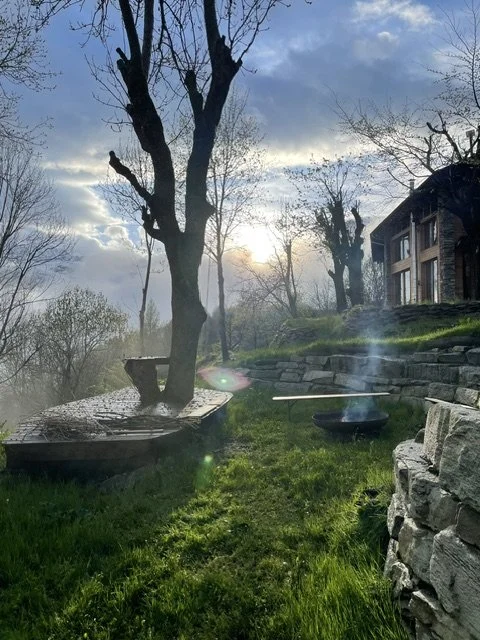
Back in the Passivhaus, Tobias was speaking about the constant maintenance and monitoring needed to keep this architectural cell stable on the mountain. We were talking about material choices; insulation, the layering, the care built into every joint.
"Carpenter ants. I saw some moving through recently. Took a scope under the floor to check – they've found a way in!"
Gaïa intrudes.
No need to travel to the ends of the earth, or to scale a peak, to feel that raw immanence. The intrusion is always already here. The ants beneath the floorboards undo the same fantasy of mastery that takes us to the iceberg tunnel or the mountain summit. Control promises a boundary that will hold. But carpenter ants turn control into comedy.
Campagna reminds us that the cracks that emerge in a closed reality system come from the pressure of what cannot be captured. The ineffable breaks the net of control. [5] Beginning there means letting the rational be interrupted again, not to construct new systems, but to keep the limits porous, alive, unsealed: a fuzzy logic where indeterminacy is an art. Andreas gave up subjectivity at the edge, a sensory collapse, dissolving in the limit rather than pushing it. The body unmakes its own sensory field. Howes reminds us that the senses are not given but made, trained, disciplined – they are culturally mediated. [11] Ingold, too, asks us to consider that to perceive is not to receive, but to make. [12] Sensing is a world-making force.
As Stengers writes, we cannot reconcile with Gaïa. It is not like animals, or land, or air, not something with which relations can simply be re-formed. 'To compose with Gaïa' means something else entirely. It means remaining present in the face of what interrupts. It calls for a different sensibility, one not so beholden to fantasies of stabilisation or control. Extremes are everywhere when the objective is to get on top of everything. Circumambulating… to go around allows instead a distanced reverence, the space for something beyond us: where mystery makes fertile soil for the ineffable.
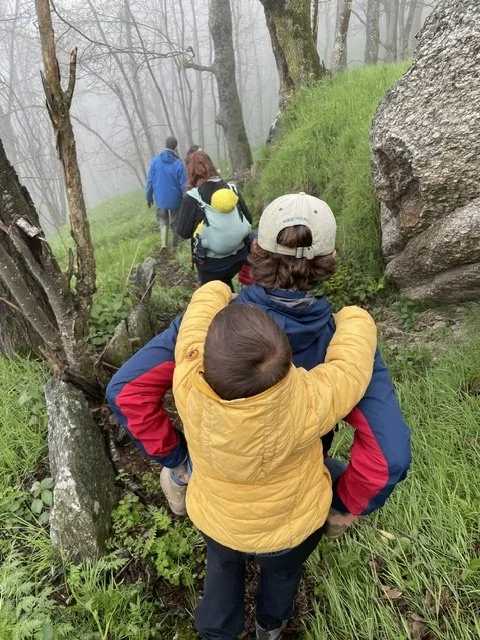
Circumambulating stays at the margin of a paradise we do not breach. Paradise: the imaginary we build to protect us from the barbarism of collapse. Its root, from the Old Persian pairi-daêzã: an enclosure, a walled garden, a stable climatic shelter against the untamed out-there. But Gaïa shows us there has never been an outside. The garden leaks. The wall, in its porosity, conspires against control. The ants are already inside.
Note
Naess, A., 1973. 'The Shallow and the Deep, Long-Range Ecology Movement: A Summary'. Inquiry: An Interdisciplinary Journal of Philosophy, 16(1–4), University of Oslo, pp. 95–100.
Naess, A., 1987. 'Self-Realization: An Ecological Approach to Being in the World'. The Trumpeter, 4(3). Available at: https://trumpeter.athabascau.ca/index.php/trumpet/article/view/623
Claudio Cattaneo, comment during panel discussion at the Degrowth Conference, Oslo, June 2025.
Robert Macfarlane, The Old Ways: A Journey on Foot, Penguin, 2012.
Federico Campagna, Technic and Magic: The Reconstruction of Reality, Bloomsbury, 2018.
Nicholas Georgescu-Roegen, The Entropy Law and the Economic Process, Harvard University Press, 1971.
Georges Bataille, The Accursed Share: An Essay on General Economy, Vol. 1, Zone Books, 1988.
Martin Heidegger, The Question Concerning Technology and Other Essays, trans. William Lovitt, Garland Publishing, 1977.
James Lovelock, Gaia: A New Look at Life on Earth, with contributions by Lynn Margulis, Oxford University Press, 1979.
Isabelle Stengers, In Catastrophic Times: Resisting the Coming Barbarism, Open Humanities Press, 2015.
David Howes, The Sensory Studies Manifesto: Tracking the Sensorial Revolution in the Arts and Human Sciences, University of Toronto Press, 2022.
Tim Ingold, The Perception of the Environment: Essays on Livelihood, Dwelling and Skill, Routledge, 2000.